Norway’s PM took questions. Modi left Indian envoy to face Norwegian media
Synced from Source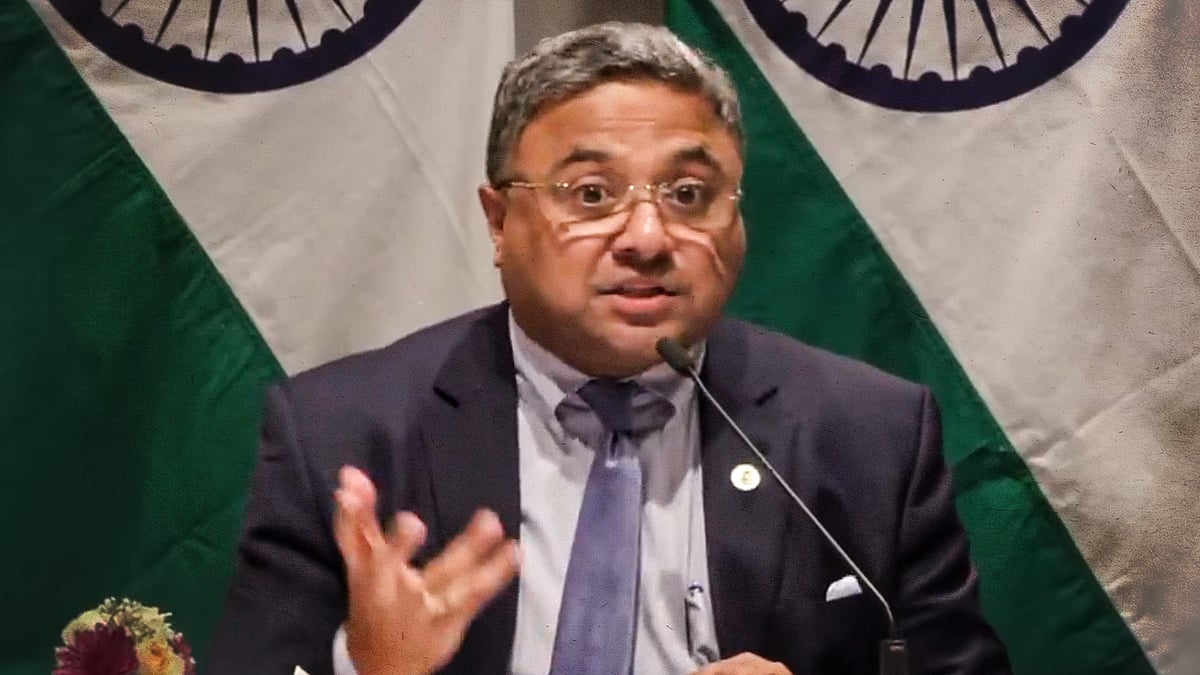
Norway’s PM took questions. Modi left Indian envoy to face Norwegian media Newslaundry
The exchange was the latest episode in a tour repeatedly shadowed by questions about press freedom.
On Monday, Prime Minister Narendra Modi had just walked off stage without taking a single question from journalists, including one shouted at him by Norwegian commentator Helle Lyng of Dagsavisen. What followed, when MEA Secretary (West) Sibi George and other ministry officials faced the media, was one of the more revealing diplomatic exchanges of Modi’s five-nation tour.
Lyng had already made her position clear before the briefing even began. As Modi walked off stage alongside Norwegian Prime Minister Jonas Gahr Støre, she had called out: “Prime Minister Modi, why don't you take some questions from the freest press in the world?” The question went unanswered, though Lyng had expected nothing less. She later wrote on X : “Prime minister of India, Narendra Modi, would not take my question, I was not expecting him to. Norway has the number one spot on the World Press Freedom Index, India is at 157th, competing with Palestine, Emirates and Cuba. It is our job to question the powers we cooperate with.”
Modi’s decision to blank Lyng as he walked out with his Norwegian counterpart had already brewed a storm back home in India, with Leader of Opposition Rahul Gandhi taking shots.
When there is nothing to hide, there is nothing to fear. What happens to India’s image when the world sees a compromised PM panic and run from a few questions?
Responding directly to Lyng’s post on X, the Indian Embassy in Norway said that it would organise a press briefing on Modi’s visit later that day and that she was “most welcome” to come and ask her questions there.
Dear Ms @HelleLyngSvends, The Embassy is organizing a press briefing on the Prime Minister’s Visit this evening at 9:30pm at hotel Raddisson BluPlaza hotel. You are most welcome to come and ask your questions there.
Unlike PM Modi, the Norwegian PM had come out to take questions from a group of Indian journalists. Though Lyng had earlier expressed disappointment that the Norwegian prime minister “did not include time today for the Indian reporters”.
I was very dissapointed that the prime minister of Norway did not include time today for the Indian reporters. I expect more of him tomorrow. @jonasgahrstore pic./dPQdaq5Xv4
Norway respects India's need to source energy, but hopes PM Modi can use Indian channels with Russia to help effect a ceasefire in Ukraine conflict, Norwegian PM Jonas Store tells me as he takes questions from a group of Indian journalists in Oslo pic./7DX03j9zqL
Later, at the press conference in the Radisson Blu Plaza Hotel in Oslo, Lyng wasn’t about to let go.
“I am wondering as we strengthen our partnership — why should we trust you?” she asked. “Can you promise that you will try to stop the human rights violations that go on in your country? And also, will the Prime Minister start taking critical questions from the Indian press at some point in the future?”
It was a pointed question. But George launched into a meandering response that touched on India's five-thousand-year civilisation, the origins of chess, the concept of zero, yoga, India's role in the G20, its Covid vaccine diplomacy, and the preamble of the Indian Constitution – before eventually arriving at the question of human rights.
“Let me answer. You ask me a question. Let me answer,” he said, his frustration audible. “When to answer, where to answer, how to answer – these are my prerogatives. You ask the question, don’t ask me to answer in a particular way.”
At one point, George told her plainly, “Please don’t interrupt me. This is my press conference.”
On press freedom, George argued that critics fundamentally misunderstand the scale of India’s media environment.
“You know how many breaking news (stories) come every day in Delhi? At least 200 TV channels – in English, in Hindi, in multiple languages,” he said. In other words, a country with 200 news channels apparently cannot be accused of suppressing its press.
On human rights more broadly, he leaned on India’s constitutional guarantees. “We have a constitution which guarantees the fundamental rights of the people,” he said. “If anyone whose rights are violated, they have the right to go to court.” He also highlighted that Indian women received voting rights at independence in 1947, earlier than women in several other nations.
On the question of minority rights, George reached for a civilisational argument rather than contemporary evidence. He described India as a society rooted in diversity and tolerance, one that had historically welcomed persecuted communities from across the world.
“India is a democratic society. It was not in 1947 that we became a democracy. We were a democratic society for centuries, for millennia,” he said.
India’s diversity, he argued, was itself proof of this tradition of acceptance. “Whenever there was persecution anywhere in the world, they came to India, and Indian society accepted everyone.” He went further, drawing an implicit contrast with other nations: “We did not eliminate, we did not go for ethnic cleansing,” he said, pointing to countries that today have “only one religion” or “only one ethnicity”. It was a sweeping historical defence that just sidestepped the present.
Discussion
Loading comments...