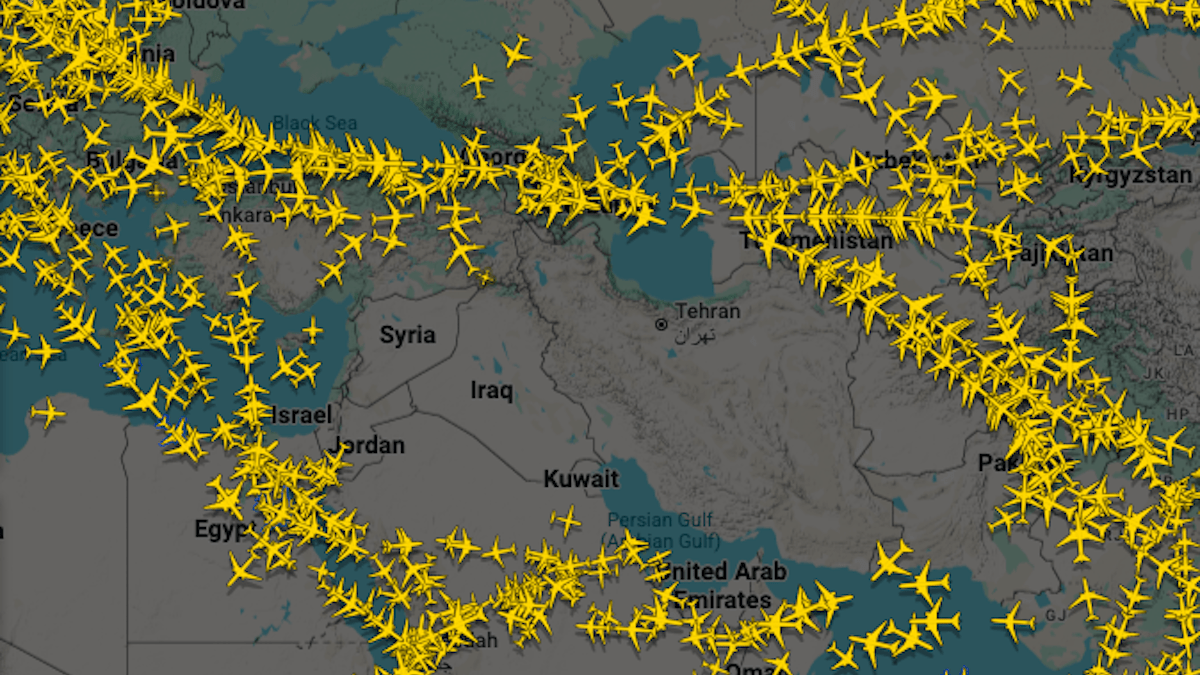
ABU DHABI: Chaos erupted at Abu Dhabi Airport as air traffic shut down due to Iranian missile strikes, leaving hundreds of thousands stranded. Major Middle Eastern airlines have canceled over 1,800 flights. Travelers are urged to check their flight status amid heightened tensions and ongoing military activity.
ABU DHABI: Air travel was thrown into turmoil on Saturday after a coordinated airstrike by the United States and Israel targeted Iranian missile sites, prompting several countries, including the United Arab Emirates, to close their airspace. This drastic measure left hundreds of thousands of passengers stranded at key airports in the Middle East, including Abu Dhabi, Dubai, and Doha, and resulted in the cancellation of more than 1,800 flights by major airlines.
The disruption was so significant that flight tracking platforms reported a complete halt in operations over the UAE, a vital hub for international air travel. This expanded shutdown not only affected regional carriers like Emirates and Qatar Airways but also caused a cascading effect, leading to international diversions and cancellations across Europe, Africa, and Asia. Aviation analysts estimate that around 90,000 passengers typically travel through these hubs daily, showcasing the magnitude of the crisis.
Henry Harteveldt, a noted airline industry analyst, stressed that travelers should brace for delays and cancellations over the coming days as the situation evolves. “For travelers, there’s no way to sugarcoat this,” he remarked, suggesting that prolonged airspace restrictions might lead to increased ticket prices as airlines reroute flights to avoid conflict zones.
Mike McCormick, a former Federal Aviation Administration official, indicated that as tensions mitigate, certain airspace portions might gradually reopen following assessments of air traffic safety. However, uncertainty remains high, with comparisons drawn to a previous military operation against Iran that caused similar disruptions lasting over a week.
In the wake of the crisis, airlines began issuing travel waivers to ease the burden on passengers, permitting them to modify their travel plans without incurring extra costs. One traveler, Jonathan Escott, shared his frustrations after his flight from Newcastle to Dubai was unexpectedly canceled. “No one knows. Emirates don’t have a clue,” he said, emphasizing the confusion that many are facing during this turbulent time.
As the situation develops, airlines and security agencies are closely monitoring the conflict and advising travelers to remain informed about flight statuses. With major airlines such as Air India and Turkish Airlines suspending flights to the region, the impact of this geopolitical upheaval on global air travel is poised to be felt for days to come.
Discussion
Loading comments...