Trump flips Monroe into Donroe: How US plans to reshape the Western Hemisphere — explained
Synced from Source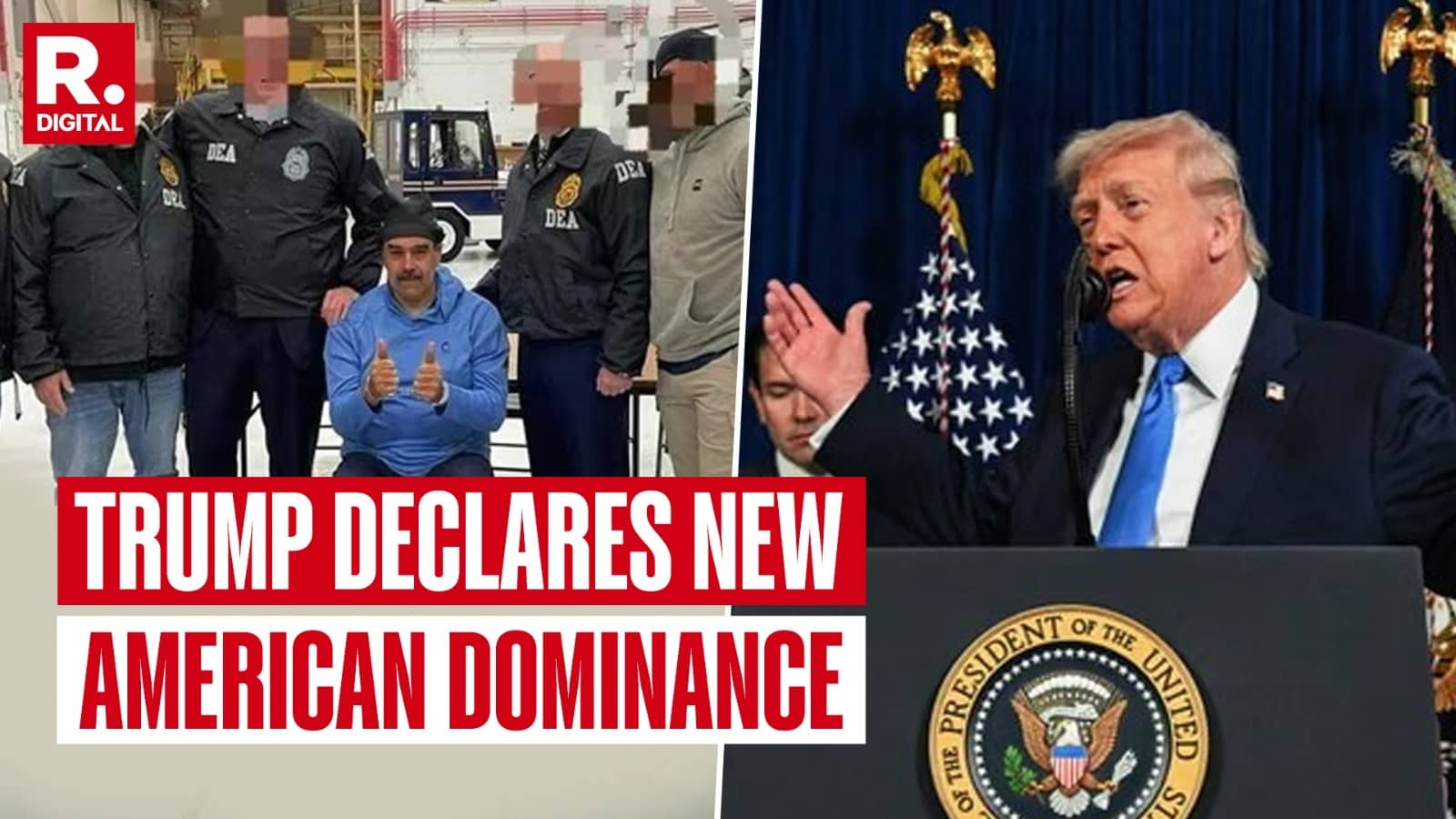
Trump flips Monroe into Donroe: How US plans to reshape the Western Hemisphere — explained Times of India
US President Donald Trump on Saturday framed the US military operation in Venezuela as the opening act of what he called the “Donroe Doctrine”, signalling a revival of American interventionism in the Western Hemisphere and declaring that US dominance in the region “will never be questioned again”.
Speaking at his Mar-a-Lago resort in Florida, Trump said the capture of Venezuelan President Nicolás Maduro marked a decisive assertion of Washington’s authority in its traditional sphere of influence, aligning the action with his “America First” agenda.
“The action in Venezuela shows that American dominance in the Western Hemisphere will never be questioned again,” Trump said, explicitly linking the operation to what he described as a modernised version of the Monroe Doctrine, an early 19th-century policy asserting US primacy in the Americas.
Trump has rebranded the doctrine as the “Donroe Doctrine”, combining his own name with that of President James Monroe, under whose administration the original policy was articulated.
Under Trump’s framing, Venezuela’s leadership question appeared secondary to the broader geopolitical signal. While confirming US forces had captured Maduro, Trump indicated Washington was prepared to work with Vice President Delcy Rodríguez, describing her as “essentially willing to do what we think is necessary to make Venezuela great again”.
“She said we’ll do whatever you (US) need,” Trump told reporters, referring to a conversation he said Rodríguez had with US Secretary of State Marco Rubio.
At the same time, Trump publicly dismissed opposition leader Maria Corina Machado, awarded the Nobel Peace Prize last year, saying she lacked the support to govern, dashing expectations of an immediate Opposition-led transition.
“I think it would be very tough for her to be the leader,” Trump said, adding, “She doesn’t have the support or respect within the country.”
The remarks came as Venezuelans struggled to grasp the implications of Maduro’s capture. Streets in Caracas emptied, long queues formed outside supermarkets and fuel stations, and residents spoke of fear and confusion.
Venezuela’s Supreme Tribunal of Justice ordered Rodríguez, next in the constitutional line of succession, to assume the role of interim president. However, no swearing-in ceremony was broadcast, and Rodríguez continued to be identified as vice president on state television.
In a televised address, Rodríguez rejected U.S. claims of cooperation, demanded Maduro’s immediate release, and denounced the American operation as a violation of international law.
“There is only one president in this country, and his name is Nicolás Maduro,” she said.
Senior military officials struck a defiant tone. Defence Minister Gen. Vladimir Padrino López accused the United States of aggression, while Interior Minister Diosdado Cabello urged supporters to take to the streets to defend Venezuela’s sovereignty.
The original Monroe Doctrine, announced in 1823, declared that the Western Hemisphere was off-limits to European colonial expansion. In 1904, President Theodore Roosevelt expanded it, asserting the US right to intervene in Latin American countries unable to maintain stability, a rationale later used to justify US interventions in Haiti, Nicaragua and the Dominican Republic.
By invoking and rebranding the doctrine, Trump appeared to signal a return to a more assertive U.S. posture in Latin America, one that places strategic control and influence above democratic transitions.
Analysts say Venezuela could be the first test of this revived doctrine, with Washington prioritising stability, energy interests and regional dominance over ideological alignment.
Trump offered no indication that Venezuela would be the last case.
“We can’t take a chance that somebody else takes over Venezuela that doesn’t have the good of the Venezuelan people in mind,” he said, a remark being interpreted as a warning to governments across Latin America.
Early Saturday, multiple explosions rang out, and low-flying aircraft swept through Caracas. Maduro’s government accused the U.S. of hitting civilian and military installations, calling it an “imperialist attack” and urging citizens to take to the streets.
The assault lasted less than 30 minutes, and the explosions, at least seven blasts, sent people rushing into the streets, while others took to social media to report what they saw and heard.
The covert US military mission, Operation Absolute Resolve, that plucked Venezuela leader Nicolas Maduro from power and removed him from the country, was the result of months of surveillance, rehearsals and interagency coordination.
Discussion
Loading comments...